
Most schedules do not slip in the field. They slip in a factory queue nobody entered in time.
A crew can recover a lost week. It cannot recover a transformer that was never ordered. When the equipment that energizes or controls a building arrives months after the building is ready for it, the project does not have a construction problem — it has a procurement decision made too late, then recorded as a schedule delay. You do not expedite your way out of a 100-week lead time in week 90.
The numbers have moved — the planning assumptions have not
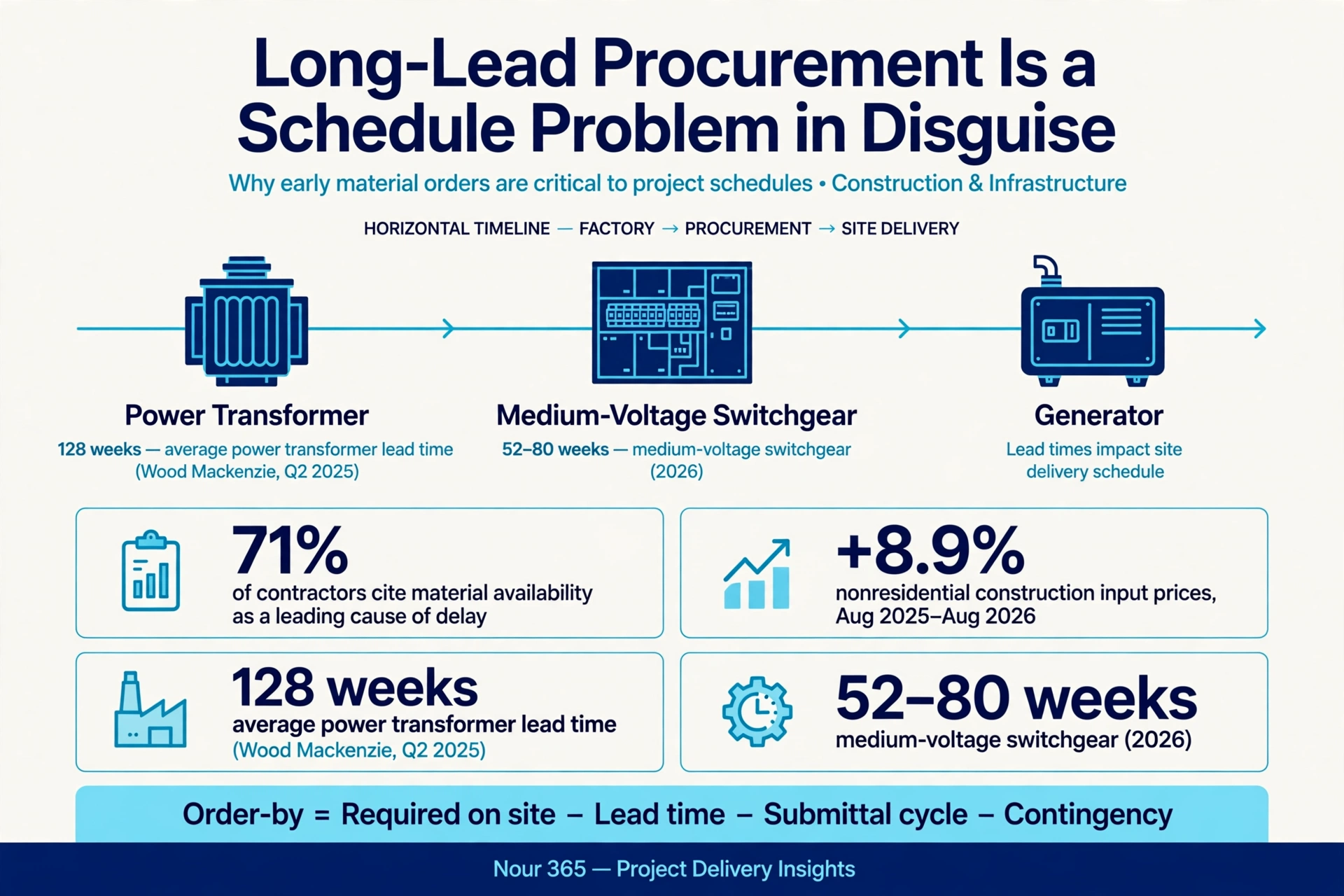
In Wood Mackenzie's benchmark, switchgear took 44 weeks on average in the second quarter of 2025, and power transformers averaged 128 weeks from receipt of order. Generator step-up transformers took more than 160 weeks by the first quarter of 2026. Demand for power transformers is up 116% since 2019, against a 30% supply deficit in 2025, with about 80% of U.S. supply imported.
Current 2026 procurement data tells the same story: medium-voltage switchgear at 52 to 80 weeks, pad-mount transformers 40 to 65 weeks, substation transformers 75 to 110 weeks, and large diesel generators 50 to 78 weeks — two to four times pre-pandemic norms. A schedule that still assumes 24 weeks for switchgear is not optimistic. It is wrong.
Steel is joining the list. Contractors reporting to the Associated General Contractors of America in fall 2026 described allocations, 46-to-52-week lead times for projects needing more than 300 tons of fabricated product, joist lead times of nine to ten months, and price increases of $600 to $700 per ton.
Layer price on top of time. Nonresidential construction input prices rose 8.9% from August 2025 to August 2026, with steel mill products up 23.4% and aluminum up 27.3%. About 55% of contractors in AGC's September 2026 survey reported projects canceled, postponed, or scaled back in the prior six months. Material availability is already the leading cause of delay in contractor polling, cited by 71%. The item you order late will also cost more.
Four angles on the same late delivery
The owner's angle. A finished building that cannot open. Every week waiting on one piece of gear is general conditions, extended insurance, and deferred revenue — spent not on building, but on waiting.
The contractor's angle. Late procurement compresses everything downstream: work resequenced around missing equipment, crews remobilized, temporary systems in place longer than priced. The float meant to protect completion was quietly spent months earlier, at buyout — it just was not recorded there.
The field's angle. A missing item does not look like one delayed activity. It looks like blocked work: rough-in complete but not testable, inspections that cannot be called, a look-ahead full of starts that cannot finish.
The commercial angle. Ordered early, equipment can be bid across manufacturers on delivery slot as well as price, with alternates in reserve. Ordered late, there is one seller, one slot, and one price — plus expediting and escalation exposure. Early, disciplined procurement planning in U.S. operations has delivered 10–15% procurement savings; late procurement delivers the opposite.
The fix, layer one: corrective action when the item is already late
If a critical item is already behind, do not start with a revised completion date. Start with the truth about the queue.
Verify the real position. Get the factory slot, submittal status, and ship date in writing from the manufacturer. Verify progress data before planning recovery — PMI's discipline applies to procurement exactly as to the schedule.
Do the math in reverse, in public. Lay out required-on-site date, factory lead time, submittal-and-approval cycle, and install-test-energize time. The gap between true delivery and required date is the problem — sized honestly, not rounded down.
Work the critical path only. Re-sequence what can genuinely proceed, fast-track independent work, and protect completed work. Do not crash unrelated activities to create the appearance of recovery.
Price the alternatives, then get endorsement. Alternate manufacturers, a faster configuration, temporary systems, phased energization — each has a cost and a schedule value. Put both in front of the owner, decide once in writing, and have stakeholders sign the recovery plan, budget, and manpower consequences.
The fix, layer two: prevention — build procurement into the schedule, not beside it
Prevention is a system, and it fits on one page:
- Build the procurement log at kickoff, not at buyout. Every long-lead item gets a named owner, a specification section, and four linked dates: submittal due, approval due, order-by, and required-on-site. If an item has no order-by date, it has no plan.
- Calculate order-by honestly. Order-by = required-on-site, minus factory lead time at the top of the current range, minus the full submittal cycle including one revise-and-resubmit, minus contingency. Using the low end of a lead-time range is how projects lie to themselves.
- Treat submittals as procurement activities. Approval is not paperwork before the clock starts — for engineered equipment, it is the first segment of the lead time. Sequence critical submittals first, review for conformance before they go to the design team, and age them weekly like any other critical work.
- Reserve the slot before the design is perfect. Where manufacturers allow it, hold a production slot on a preliminary specification during preconstruction. Waiting for 100% documents before entering a 70-week queue hands the schedule to the factory.
- Specify alternates in advance. Two acceptable manufacturers for every critical package, approved before they are needed, so a slipped slot triggers a substitution — not a redesign.
- Write escalation protection into the contract. Dated quotes with hold periods, and a price-escalation provision tied to an agreed index for exposed materials, agreed at signing — not negotiated after the spike.
- Expedite as a routine, not an emergency. A monthly procurement review that checks factory status, submittal aging, and order-by dates falling due in the next 90 days. The review is boring. That is the point.
What this means for owners and primes
Ask one question at award: show us the procurement log. Not the schedule — the log, with order-by dates worked back from today's lead times, owners named, and alternates approved. The teams that can show it will protect your completion date. The teams that show a schedule built on 2019 lead times have already spent your float; they just have not told you yet.
That is the work Nour 365 does: PMP-led project controls and reporting, procurement and delivery planning, closeout and turnover, and embedded delivery leadership for owners and primes — on $50M+ programs with teams of up to 150, as a subconsultant in full-and-open competition, SAM.gov Active. New England on-site, remote nationwide.
If your next project's completion date depends on equipment with a lead time longer than your procurement plan, the time to fix that is now — while fixing it is still cheap. Book a 30-minute scoping call and we will work through your long-lead list and tell you plainly where the exposure sits.
Sources
- Wood Mackenzie, Mind the gap: tackling supply-chain challenges in the electric T&D sector (Oct 15, 2025), via the Load Atlas lead-time benchmark — switchgear 44 weeks average and power transformers 128 weeks average in Q2 2025; generator step-up transformers more than 160 weeks by Q1 2026 (reported via Reuters, Jul 9, 2026); power transformer demand up 116% since 2019; 30% supply deficit in 2025; about 80% of U.S. power transformer supply imported. https://theloadatlas.com/guides/transformer-switchgear-lead-times/
- Terrapin Construction Group, Switchgear, Transformer, and Generator Lead Times in 2026 (updated November 2026) — medium-voltage switchgear 52–80 weeks; pad-mount transformers 40–65 weeks; substation transformers 75–110 weeks; 1.5–3 MW diesel generators 50–78 weeks; lead times 2–4× pre-pandemic norms. https://terrapincg.com/news/switchgear-transformer-generator-lead-times-2026
- Associated General Contractors of America, Data Digest, Vol. 26 No. 38 (Oct 5–9, 2026) — contractor reports of steel allocations, 46–52-week lead times for projects requiring more than 300 tons of fabricated product, joist lead times of 9–10 months, and price increases of $600–$700 per ton. https://www.agc.org/sites/default/files/Files/Communications/datadigest20261009.pdf
- AGC September 2026 survey via Construction Dive — producer price index for nonresidential construction inputs up 8.9% Aug 2025–Aug 2026; steel mill products +23.4%; aluminum mill shapes +27.3%; diesel fuel +77.8%; about 55% of contractors reported projects canceled, postponed, or scaled back in the prior six months. BDC Network contractor poll: material availability / supply chain issues cited by 71% of contractors as a cause of delay. PMI recovery discipline: verify progress data before planning recovery; obtain stakeholder endorsement of the recovery plan. https://www.constructiondive.com/news/cost-spikes-construction-materials-producer-price-index/830165/ and https://www.bdcnetwork.com/building-team/contractors/news/55289354/a-poll-of-contractors-recounts-perennial-reasons-for-project-delays
Start with a 30-minute scoping call.
Tell us where the program needs support — we will confirm a start plan on the call.